 EN
EN

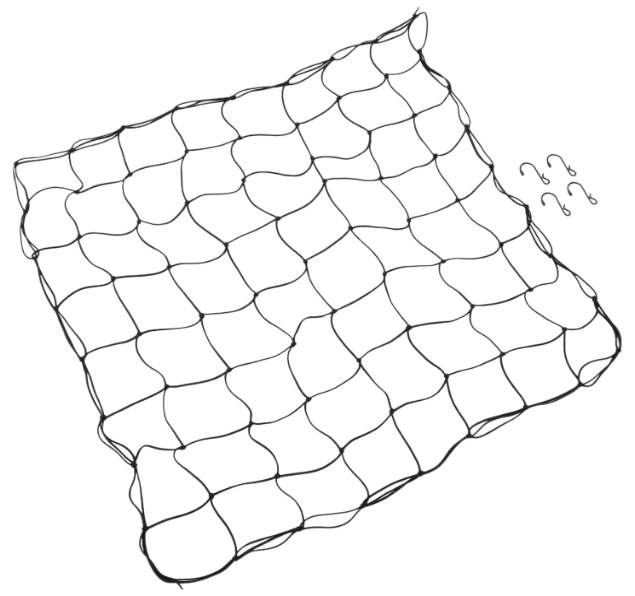
A scrog net is one of the most effective tools available to indoor cultivators seeking to improve both plant architecture and the productive use of grow space. By training plants to grow horizontally through a woven mesh screen, growers can fundamentally change how canopy light is distributed, how lateral branches develop, and how efficiently a given footprint is used. Whether you are working inside a compact grow tent or a larger dedicated cultivation room, a scrog net brings measurable structural and spatial benefits that directly support crop performance.
Understanding exactly how a scrog net functions requires looking at both plant biology and cultivation physics together. When growers weave stems through the scrog net grid, they redirect vertical energy into lateral spread. This process encourages the plant to produce multiple flowering or fruiting sites at a relatively uniform canopy height. The scrog net essentially acts as a structural anchor and a growth-guiding framework simultaneously, giving cultivators active control over plant shape rather than letting natural apical dominance dictate the final form.
How Scrog Net Reshapes Plant Structure
Redirecting Apical Dominance with a Scrog Net
Most plants naturally channel their growth energy upward toward a single dominant tip. This vertical tendency, known as apical dominance, concentrates resources in one main stem while side branches remain comparatively underdeveloped. A scrog net interrupts this pattern by physically holding the main stem at a fixed horizontal plane. Once the dominant tip is anchored by the scrog net, the plant redistributes growth hormones more evenly, stimulating lower lateral branches to accelerate upward and fill the available grid openings. Over time, each branch becomes a productive shoot of roughly equal height, creating a far more uniform and productive canopy.
The scrog net provides consistent mechanical resistance that encourages the plant to strengthen its lateral stems. Growers who use a scrog net regularly observe thicker secondary branches, improved stem density, and a more robust overall structure compared to plants trained without support. This structural improvement also means plants are better able to carry the weight of dense flowers or fruit as they mature.
Building a Multi-Site Canopy Through Scrog Net Training
One of the most notable structural outcomes of using a scrog net is the development of a multi-site canopy. Rather than producing one primary cola or fruiting point, plants trained with a scrog net develop numerous equally developed sites across the horizontal plane. Each opening in the scrog net grid holds a branch at a consistent height, effectively turning a single plant into a production matrix. For cultivators focused on maximizing yield per plant, this transformation is central to why the scrog net method is so widely adopted in serious indoor growing operations.
How Scrog Net Maximizes Space Efficiency
Using Horizontal Space Rather Than Vertical Height
Grow tents and indoor cultivation rooms have fixed physical dimensions. Without any training, plants often waste significant horizontal space while exceeding the ideal vertical distance from the light source. A scrog net solves both problems at once. By spreading the plant canopy across the full width of the growing area, the scrog net ensures that every square centimeter of illuminated floor space contributes to photosynthesis and production. Light energy that would otherwise fall on empty substrate or air is instead captured by leaves spread evenly beneath the scrog net canopy.
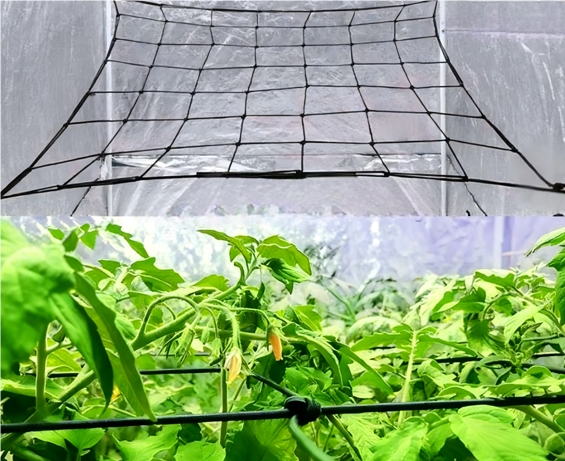
The scrog net also helps maintain a consistent canopy-to-light distance across the entire grow area. When all tops are held at roughly the same height by the scrog net, every part of the canopy receives light at approximately the same intensity. This uniformity eliminates the hot spots and shadow zones that typically form when plants grow unevenly, making lighting investment far more efficient when a scrog net is used correctly.
Fitting More Productivity Into a Fixed Footprint
In commercial and semi-commercial growing contexts, floor space directly represents cost. The scrog net allows growers to extract more productive canopy from fewer plants, which can reduce input costs related to growing media, nutrients, and seed or clone stock. A single well-trained plant under a scrog net can fill the same canopy footprint that would otherwise require multiple untrained plants. This efficiency gain is especially valuable in licensed or regulated growing environments where plant counts are limited but space is available.
The scrog net also simplifies airflow management. Because the canopy is spread flat and open rather than dense and vertical, air moves more freely through and around the plant structure. Better air circulation reduces humidity pockets and lowers the risk of fungal issues, which is another practical way that the scrog net contributes to operational efficiency beyond just space use.
Practical Factors When Working With a Scrog Net
Choosing the Right Scrog Net for Your Setup
Not every scrog net is equally suited to every growing environment. Grid opening size, mesh elasticity, and overall net dimensions all influence how well the scrog net performs with a given plant variety and container size. An elastic scrog net made from flexible materials is generally easier to weave and reposition than a rigid version, making it more forgiving for newer growers learning the technique. The scrog net should be sized to span the full interior width of the grow tent or growing area so that no productive space falls outside the training grid.
Installation height is another important variable. The scrog net should be positioned above the plant canopy early in the vegetative stage, typically around twenty to thirty centimeters above the growing medium. This allows plants enough room to develop before being introduced to the scrog net grid. As branches reach the scrog net, growers guide them through openings and allow them to grow horizontally until the grid is densely covered before allowing vertical growth to resume.
Timing and Ongoing Management of Scrog Net Training
Successful scrog net training is an ongoing process rather than a one-time setup. Growers must regularly tuck new growth under the scrog net and position shoots into unfilled grid sections during the vegetative phase. Consistent management ensures that the scrog net fills evenly, preventing any single branch from dominating the canopy at the expense of others. Once the scrog net is approximately seventy to eighty percent filled, most growers transition the plant into the flowering or fruiting stage, allowing vertical growth to resume within the framework the scrog net has already established.
FAQ
What size scrog net works best for a standard grow tent?
A scrog net should match the interior dimensions of your grow tent as closely as possible. For common tent sizes, a scrog net with five-centimeter grid openings works well for most plant varieties. Elastic scrog net options offer additional flexibility for irregular frame shapes or custom grow space configurations.
Can a scrog net be reused across multiple growing cycles?
Yes, a durable scrog net made from quality elastic or nylon mesh can typically be cleaned and reused for several growing cycles. After harvest, remove plant material carefully from the scrog net grid, wash the net with mild soap and water, and allow it to dry fully before the next use. Proper care significantly extends the usable life of any scrog net.
Does a scrog net work for all plant types?
A scrog net is most effective for plants with flexible stems that can be guided horizontally without snapping. Vine-type plants, climbing crops, and bushy flowering plants respond particularly well to scrog net training. Rigid or very compact plant varieties may require additional low-stress training techniques before the scrog net method can be fully applied.