 EN
EN

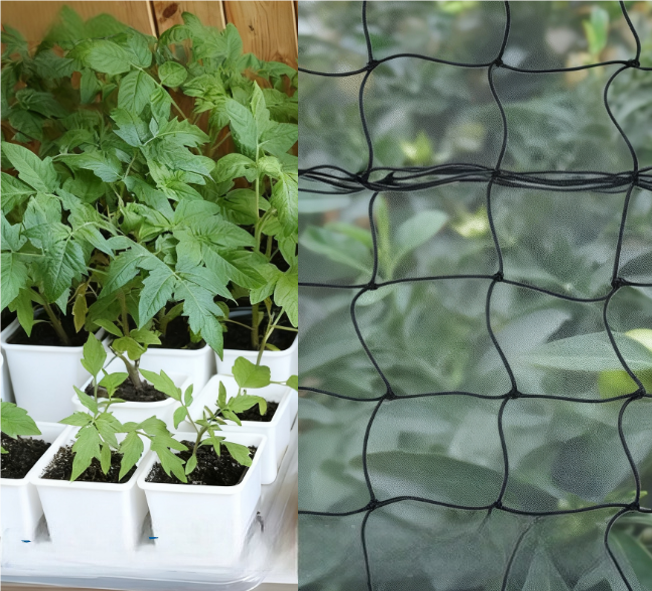
Scaling plant support systems from a small grow tent to a full commercial operation is one of the most practical challenges growers face today. A trellis net that performs well in a controlled indoor setup must be rethought, resized, and restructured before it can reliably serve the demands of a commercial farming project. Understanding how to make that transition intelligently is key to protecting yield consistency and controlling infrastructure costs across large growing areas.
A trellis net used commercially must do more than hold plant stems in place. It must integrate with row spacing configurations, support mechanical or semi-mechanical harvesting workflows, and endure repeated growing cycles without losing structural integrity. When growers approach the trellis net question with commercial intent, material choice, installation method, and grid geometry all become critical planning variables rather than secondary considerations.
Structural Considerations When Scaling Trellis Net Systems
Grid Size and Spacing for Commercial Plant Density
One of the first adaptations required when bringing a trellis net into a commercial farming environment is adjusting the grid opening size to match the crop variety and target canopy density. In small-scale setups, a standard grid is often sufficient. At commercial scale, the trellis net must be specified to accommodate the actual stem diameter, branching pattern, and horizontal spread of the chosen variety. A grid that is too tight restricts lateral growth and increases labor time during training. A grid that is too open provides insufficient support as stem weight increases through the flowering or fruiting phase.
Commercial growers typically work with plant densities that vary significantly by crop type. The trellis net must be planned in relation to row width, bed length, and the number of plants per square meter. This means ordering or fabricating the trellis net to custom dimensions rather than using off-the-shelf standard widths. Many commercial projects also require the trellis net to span longer horizontal distances than standard retail products support, which makes modular or roll-format options far more practical for large-scale deployment.
Material Durability and Reusability at Scale
At commercial scale, the cost of a trellis net must be evaluated across multiple growing cycles rather than as a single-use expense. Elastic trellis net materials, particularly those made from UV-stabilized polypropylene or high-tenacity nylon, offer the combination of flexibility and durability that commercial environments demand. A trellis net that stretches under load without snapping allows plants to grow naturally while remaining supported, and it recovers its original shape after the harvest cycle when properly maintained.
Reusability is a direct cost factor. A trellis net that degrades after one season forces replacement costs that erode the economic benefit of the system. Commercial farming projects benefit most from a trellis net rated for multiple seasons, with resistance to humidity, UV exposure, and the chemical residues common in professional growing environments. Evaluating the trellis net by its lifecycle cost rather than its unit price is the correct commercial approach.
Integration of Trellis Net with Commercial Growing Infrastructure
Horizontal vs. Vertical Trellis Net Deployment
Commercial farming projects use the trellis net in two primary orientations depending on the crop type and training method. Horizontal trellis net deployment is the dominant approach for dense canopy crops such as tomatoes, cucumbers, peppers, and cannabis. In this configuration, the trellis net is suspended at one or two canopy heights above the growing bed, allowing lateral stems and flowering sites to rest on the net surface and spread evenly without crowding. This approach maximizes light penetration across the canopy and reduces the manual labor required for stem training.
Vertical trellis net deployment suits climbing crops and vine-type plants that require upward support rather than horizontal spread. For commercial vine production, the trellis net is anchored to overhead rails or post systems and allows individual stems to climb within defined grid cells. This method is particularly common in greenhouse tomato and cucumber operations where row length runs into the tens of meters. A correctly specified trellis net in a vertical system becomes part of the permanent infrastructure, guiding plant growth from early vegetative stage through to final harvest without requiring replacement mid-cycle.
Compatibility with Irrigation and Harvesting Systems
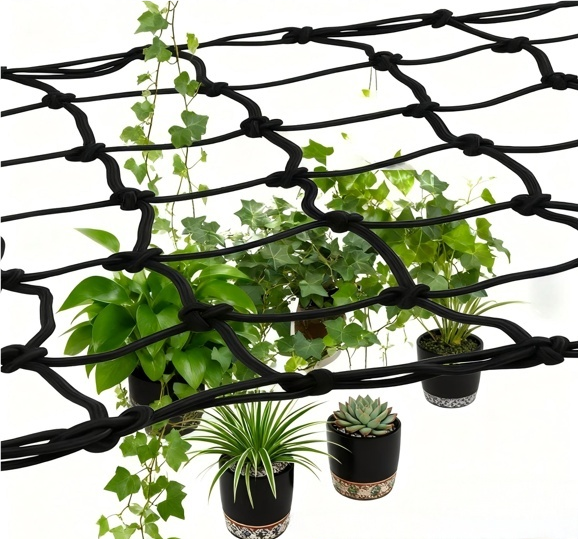
A commercial trellis net must be installed in a way that does not obstruct drip irrigation lines, overhead misters, or fertigation systems. In professional greenhouse environments, the trellis net is positioned relative to emitter placement so that water and nutrient delivery remains unimpeded at every plant station. This requires pre-planning the trellis net anchor points in coordination with the irrigation layout rather than retrofitting one system around the other.
Harvesting workflow compatibility is equally important. A trellis net that tangles with harvesting equipment or slows manual picking significantly reduces labor efficiency during the most time-sensitive phase of the growing cycle. Commercial operations often choose trellis net products with larger grid openings or softer elastic construction specifically to facilitate faster plant removal and cleaner stem release at harvest. The trellis net design should be treated as an active component of the harvesting workflow, not merely a passive support structure.
Planning and Deployment Strategy for Commercial Trellis Net Projects
Phased Rollout Across Growing Zones
Large commercial farming operations benefit from deploying the trellis net in phases rather than attempting a full facility installation at once. A phased approach allows the growing team to test anchor spacing, grid height, and net tension in one or two pilot zones before committing to full-scale installation. Lessons learned during the pilot phase often reveal adjustments in trellis net specification that would have been costly to correct after facility-wide installation. Phased rollout also distributes capital expenditure across multiple budget cycles, which is relevant for operations scaling from mid-size to full commercial capacity.
Staff Training and Ongoing Maintenance
A trellis net system only delivers its full value when the growing team understands how to use it correctly. Commercial farming projects should include a staff training component that covers proper trellis net tensioning, stem placement technique, and the correct method for releasing plants at harvest without damaging the net. Improper handling is the primary cause of premature trellis net degradation in commercial environments. Establishing a maintenance protocol for inspecting the trellis net between cycles, cleaning residue, and checking anchor points ensures the system performs reliably across its full expected service life.
FAQ
What trellis net material works best for commercial greenhouse farming?
For commercial greenhouse environments, a trellis net made from UV-stabilized polypropylene or elastic nylon is typically the most suitable choice. These materials offer the flexibility needed to accommodate plant movement under load while maintaining structural integrity across multiple growing cycles. The trellis net material should also resist humidity and chemical exposure common in professional growing conditions.
How do I determine the correct grid size for my trellis net in a commercial setting?
Grid size selection for a commercial trellis net depends on the specific crop variety, its branching habit, and the target plant density per square meter. Growers should measure the average stem diameter and horizontal spread of mature plants under their specific conditions, then select a trellis net grid opening that allows natural growth without excessive restriction or insufficient support. Consulting the trellis net supplier with detailed crop specifications helps ensure the correct product is specified before installation.
Can the same trellis net be reused across multiple growing seasons?
Yes, a quality trellis net designed for commercial use can typically be reused across multiple growing seasons when properly maintained. After each harvest cycle, the trellis net should be inspected for damage, cleaned of plant residue, and stored in a manner that prevents UV degradation when not in use. Elastic trellis net products made from durable synthetic materials are particularly well-suited to multi-season reuse in commercial farming projects, offering a favorable return on investment over time.